 TRADING FOUNDRY
What Scalping Is — and Who Should Not Do It.
Define scalping strictly, list what the format demands, and decide honestly whether you are the narrow profile it suits before you risk a penny on it.
Scalping has the best marketing in retail trading. Quick trades, small stops, money made before the coffee goes cold. The reality is less photogenic: scalping is the most expensive trading format per pip of edge, the most mentally fatiguing, and the least forgiving of sloppiness. It can be done well. Most people who try it do it badly, and the reasons are structural rather than personal.
This course teaches one complete scalping method — a four-step plan on the 5-minute chart with optional refinement on the 1-minute — and it teaches the arithmetic and the operating discipline that decide whether that method has any chance of working for you. We will be honest throughout, including in this first lesson, where the honest answer for many readers is "not yet, and possibly not ever". That is a perfectly good outcome. It costs a few evenings rather than an account.
A definition worth being strict about
Scalping is taking many small, short-duration trades on low timeframes — usually the 1-minute and 5-minute charts — held for minutes rather than hours, and judged inside the session they were opened. The scalper is not trying to ride a trend from start to finish. The aim is to capture a small, repeatable slice of a move that the market's short-term behaviour makes likely: a pullback ending inside a trend, a level holding after a test, a session open pushing in the direction the bigger picture already favours.
In this course a scalp has four fixed properties. It has a defined trigger, an observable candle event you could point at on a screen. It has a stop measured in single-digit pips on the major pairs — five to eight pips on EUR/USD in our plan. It has a target fixed in advance as a multiple of that stop, which we will call R. And it has a holding time short enough that the trade is usually resolved within half an hour.
That rules out a lot of what people call scalping. Two trades a day held for three hours is day trading. Closing a swing trade early because it frightened you is not scalping either; it is nerves with a fast exit. The distinction matters because the numbers change completely once targets shrink to single digits.
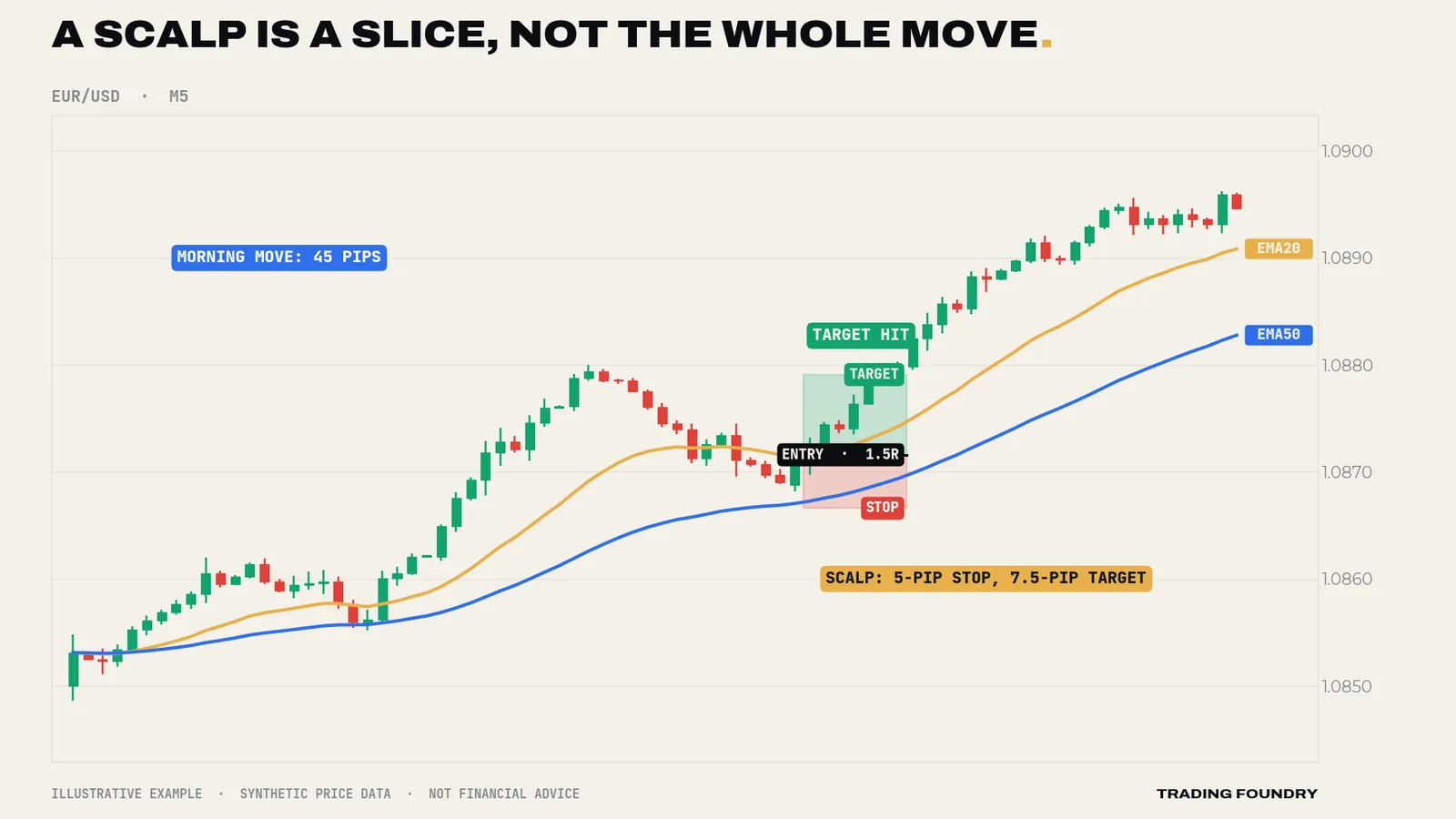
The core ratio: error and cost as a fraction of target
Here is the single idea that drives the whole course. Every trade pays a toll — spread, commission and slippage — and every trader makes small execution errors. Those tolls and errors are roughly fixed in pips. Your target is not.
A swing trader aiming for 80 pips who enters a pip late has given away just over 1% of the target. A scalper aiming for 7.5 pips who enters a pip late has given away 13%. Add a typical all-in toll of around 1 pip and the scalper is surrendering more than a quarter of every winner before the market has done anything at all. Lesson 2 does this arithmetic properly. For now, hold on to the shape of it: small targets do not reduce cost, they concentrate it.
What the format actually demands
It is worth listing the demands bluntly, because each one is a legitimate reason not to scalp.
Time, in unbroken blocks. You cannot scalp around a job by glancing at a phone. The plan in this course trades one of two windows — the London open or the London–New York overlap — and needs your full attention for around two hours. Miss a trigger by thirty seconds and it has gone.
Cheap, fast execution. You need raw-spread pricing, low commission, a platform that does not freeze when the market gets busy, and fills you have measured rather than read about. Costs that are trivial for a swing trader decide whether a scalper can win at all.
One rehearsed play. Fast decisions only stay accurate when they are binary: is this my setup, yes or no? A trader with five setups on a 1-minute chart is answering an essay question every candle. This course gives you one setup, and asks you to drill it until recognising it takes seconds.
Emotional durability. A normal session might hold four to six trades. Losses cluster. You can follow every rule and still take three losers in a row before ten o'clock, purely from variance. If that sequence makes you change the rules, the format will take you apart.
Hard limits, set in advance. Because the trade cycle is fast, drawdowns are fast. A bad hour of scalping can do what a bad month of swing trading does. Daily loss limits and trade caps are structural parts of the method, not optional extras, and Module 4 treats them that way.
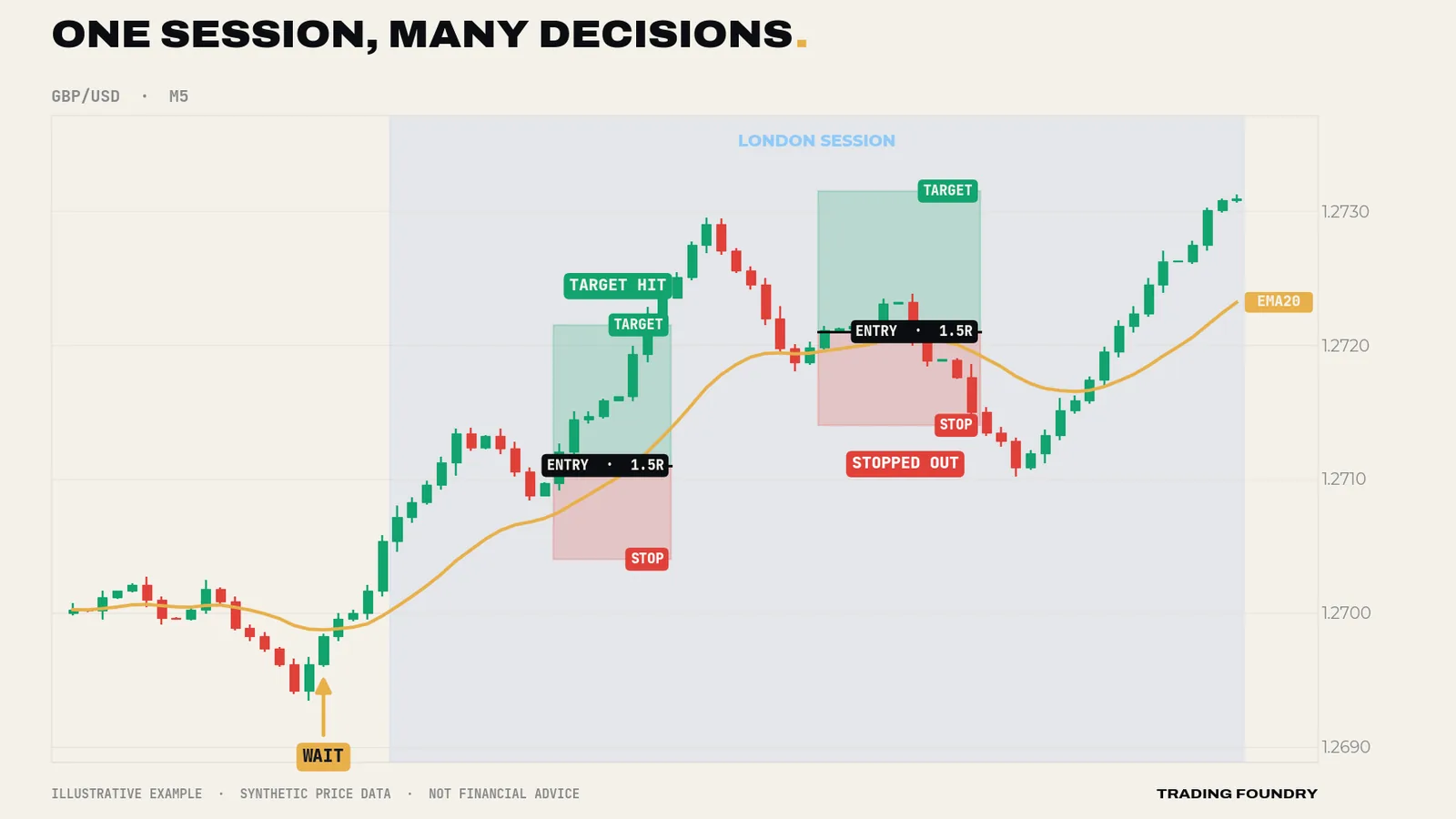
Who should not scalp
Here is the editorial position of this course, stated early so nobody can say it was buried: most traders should not scalp, and almost nobody should start their trading life with it.
The reasons are not about intelligence.
Costs. As Lesson 2 shows, scalping pays the highest toll per pip of edge of any format. You need a genuinely strong edge just to break even, whereas a trader on the 4-hour chart can survive with a modest one.
Feedback. Scalping produces so many trades that bad habits are reinforced dozens of times a week before you notice them. A swing trader who chases entries does it twice a month. A scalper who chases does it twice an hour.
Physiology. Sustained rapid decision-making under financial pressure is tiring, and fatigue degrades exactly the discipline the format depends on. The rule-follower at 08:15 is often a rule-bender by 10:00.
Life. If your free time is in the evening, you are looking at the Asian session on European pairs: thin, slow and relatively expensive. That is not a scalping market for EUR/USD or GBP/USD, and no amount of enthusiasm changes it.
So who is it for? A narrow profile: someone with proven discipline on higher timeframes, who can follow written rules under pressure, has two free hours at a consistent time that overlaps London or New York, has access to genuinely low-cost execution, and finds repetition calming rather than boring. If that is not you today, the honest move is to keep trading slower formats and come back to this course when it is.
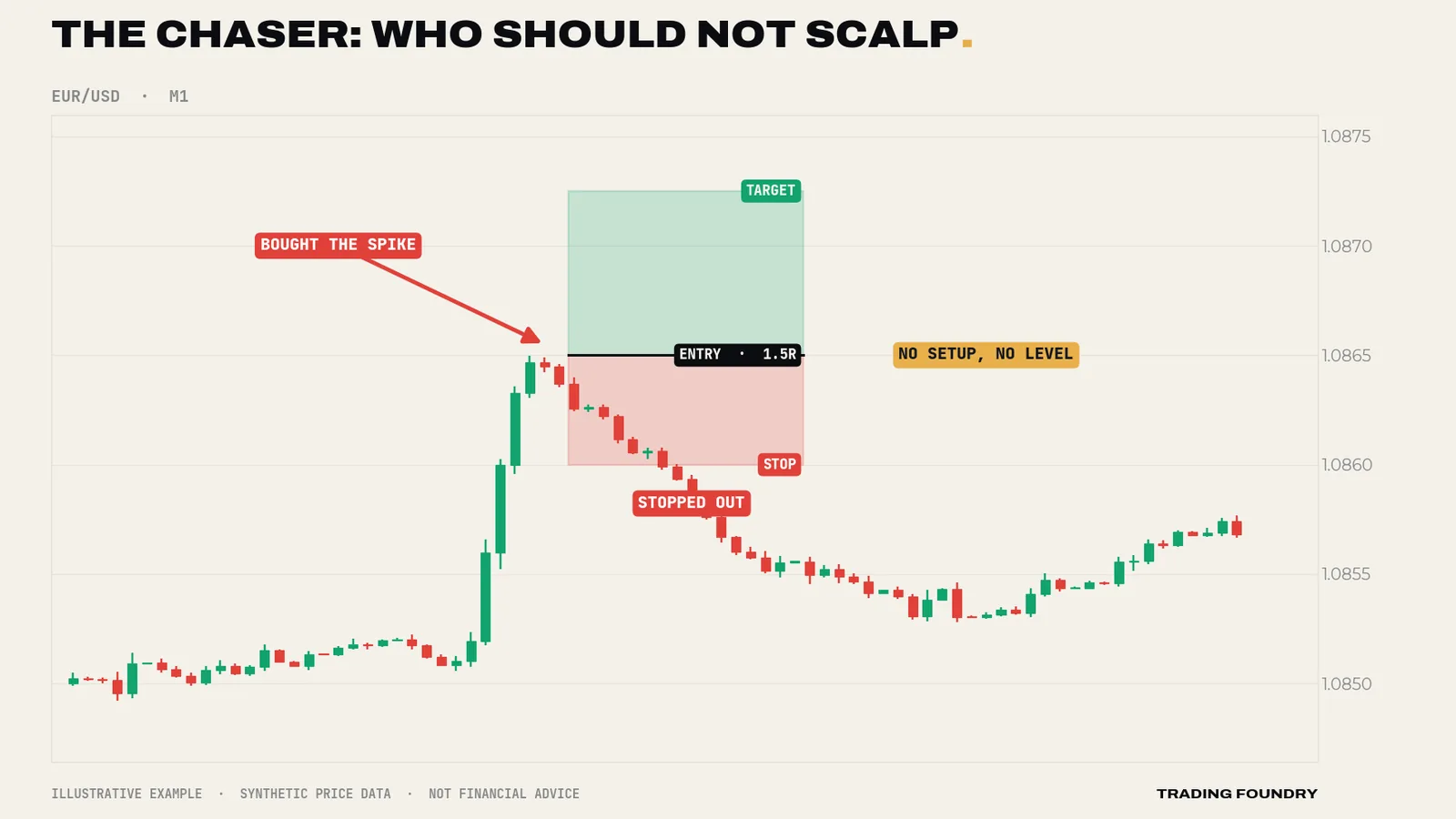
What "mastery" means in this course
Mastery here is not predicting price to the pip. Nobody does that. It means four precise things:
- Precise knowledge of your costs — your all-in round-trip toll, measured, written on a card.
- A precisely defined setup — the four-step 5-minute plan, with every condition stated so that two honest people watching the same chart would agree whether it triggered.
- Precise execution — orders chosen in advance, stops attached at entry, size pre-set, the emergency exit rehearsed.
- Precise limits on your behaviour — a daily loss limit, a trade cap, a consecutive-loss breaker and a session that ends by the clock.
The course is built in that order. Module 1 handles costs, sessions and pairs. Module 2 builds the four-step 5-minute plan. Module 3 covers 1-minute execution, candle triggers and trade management. Module 4 builds the operating system around you: limits, psychology, journaling, and a capstone playbook with complete worked trades — including losers and a session where the correct number of trades was zero.
Going deeper
For experienced traders, three points that are often misunderstood.
Scalping is a variance problem disguised as a speed problem. Because each trade risks a small amount, people assume scalping is low risk. Per trade, it is. Per session, it is not. Six trades at 0.5% risk can lose 3% in a morning; the same trader on a 4-hour chart might take three weeks to do that. What matters is how fast your daily distribution of outcomes is sampled, and scalping samples it very quickly. That is why the daily limit, not the per-trade stop, is the scalper's most important risk control.
Your edge has to survive a toll that other formats barely notice. If a strategy has a modest positive expectancy before costs — say a hypothetical +0.15R per trade — a 4-hour trader paying a toll of 0.02R keeps almost all of it. A scalper paying 0.2R per trade turns the same raw edge into a loss. Many people's 1-minute "edges" are real; they are just smaller than the toll.
Sample sizes arrive fast, which is the one genuine advantage. A swing trader needs two years to collect 200 trades. A scalper on a simulator can collect them in a couple of months. That makes scalping unusually testable. Use that advantage: the method in this course is designed to be logged, measured and judged on a few hundred simulated trades before any money is involved.
- Scalp only if you can commit two uninterrupted hours inside the London or London–New York window
- Trade one written setup, on one pair, in one session — no improvisation
- Measure your all-in round-trip cost before you take a single live scalp
- Every scalp has a stop attached at entry and a fixed target set in R
- Simulate first: at least 200 logged trades before any live risk
Summary
- Scalping is many small, short trades on M1 and M5, with single-digit-pip stops and targets fixed in R, judged inside the session.
- The defining ratio is cost and error as a fraction of target; small targets concentrate cost rather than reducing it.
- The format demands unbroken time, cheap execution, one rehearsed setup, emotional durability and hard limits — all at once.
- Most traders should not scalp; concluding that from honest testing is a success, not a failure.
- This course gives one complete method — the 4-step 5-minute plan — and the arithmetic and discipline to judge it.
Quick quiz.
Education only, not financial advice. Charts are illustrative training examples using synthetic price data, not real market history or results.