 TRADING FOUNDRY
Currency Pairs, Pips and Lots — The Units of the Market.
Read any currency quote, measure any price move in pips, and convert pips into money for any lot size — in your own account currency.
Imagine trying to follow a recipe where nobody agreed what a "cup" was. That is roughly the position of a beginner who opens a trading platform without knowing what a pip or a lot is. The numbers on the screen move, money goes up and down, and there is no way to connect the two.
This lesson fixes that. It introduces the three units everything else in forex is built on: the pair (what you are trading), the pip (how far price moved) and the lot (how much you traded). Once you can move between those three, you can answer the only question that really matters before a trade: if price goes this far against me, how much money do I lose?
There is some arithmetic here. It is all multiplication and division, and every example is worked in full. Take it slowly once; after that it becomes automatic.
Base and quote: reading a pair
Every pair has two currencies. The first is the base currency; the second is the quote currency. The price tells you how many units of the quote currency one unit of the base currency costs.
- EUR/USD 1.0850 — one euro costs 1.0850 US dollars. Base EUR, quote USD.
- GBP/USD 1.2700 — one pound costs 1.2700 dollars. Base GBP, quote USD.
- USD/JPY 150.00 — one dollar costs 150 yen. Base USD, quote JPY.
- EUR/GBP 0.8540 — one euro costs 0.8540 pounds. Base EUR, quote GBP.
When you buy a pair, you are buying the base currency and selling the quote currency. When you sell a pair, you are selling the base and buying the quote. So buying GBP/USD is a bet that the pound will strengthen against the dollar. Selling USD/JPY is a bet that the dollar will weaken against the yen.
Pairs fall into three rough groups:
- Majors — the most traded pairs, all involving the US dollar: EUR/USD, GBP/USD, USD/JPY, USD/CHF, AUD/USD, USD/CAD, NZD/USD. These have the most liquidity and usually the lowest costs. Beginners should start here.
- Crosses — pairs of major currencies without the dollar, such as EUR/GBP, EUR/JPY or GBP/JPY. Perfectly tradeable, usually a little more expensive.
- Exotics — a major currency against a smaller or emerging-market one, such as USD/TRY or EUR/ZAR. Wider spreads, sharper gaps, and more ways to get hurt. Not for this course.
What a pip is
A pip is the standard unit for measuring a price move. For almost every pair it is the fourth decimal place: 0.0001. For pairs quoted in Japanese yen, where prices are around 100 or more, it is the second decimal place: 0.01.
So:
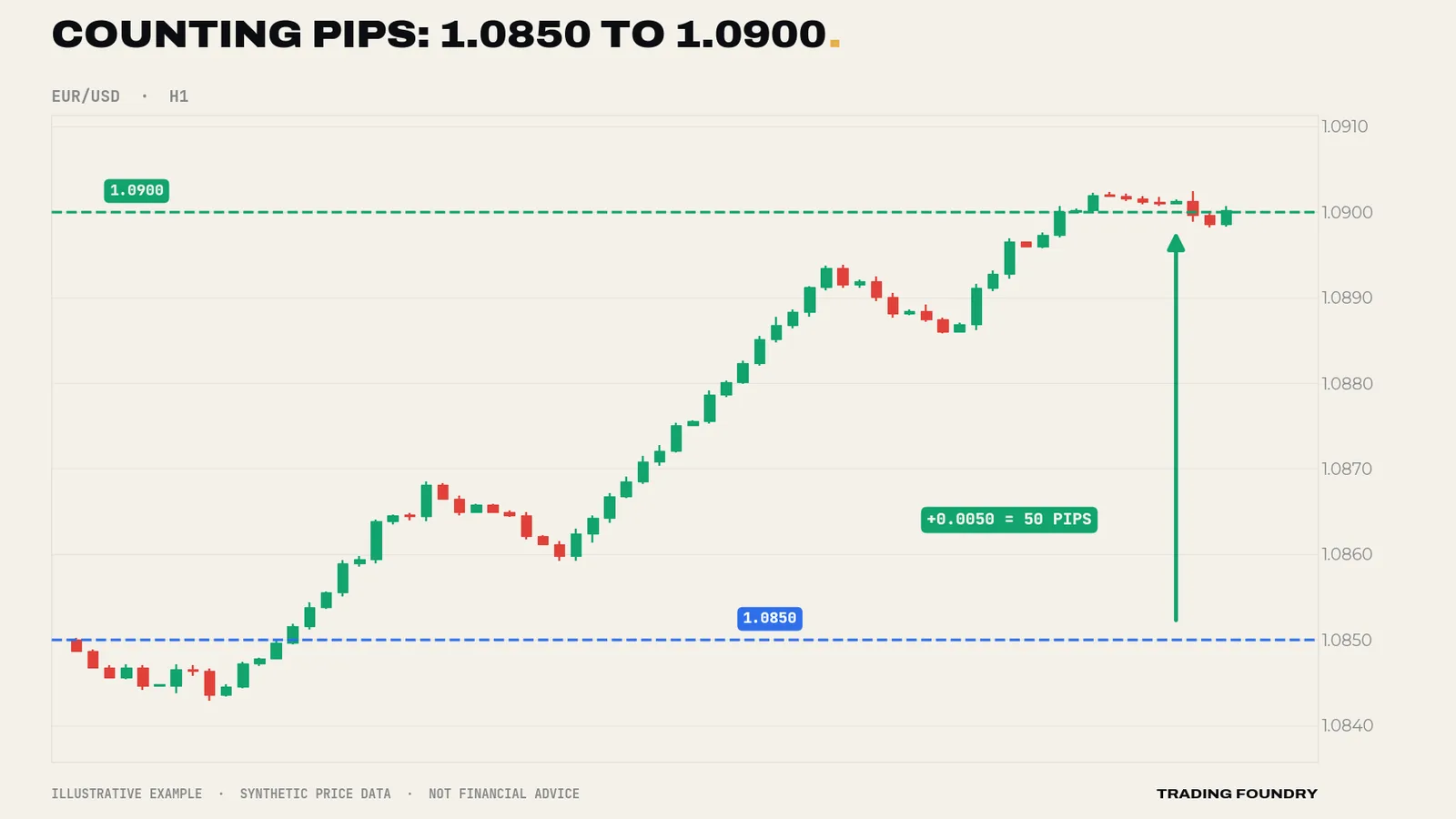
- EUR/USD moving from 1.0850 to 1.0900 is a move of 0.0050, which is 50 pips.
- GBP/USD falling from 1.2700 to 1.2665 is a move of 0.0035, which is 35 pips.
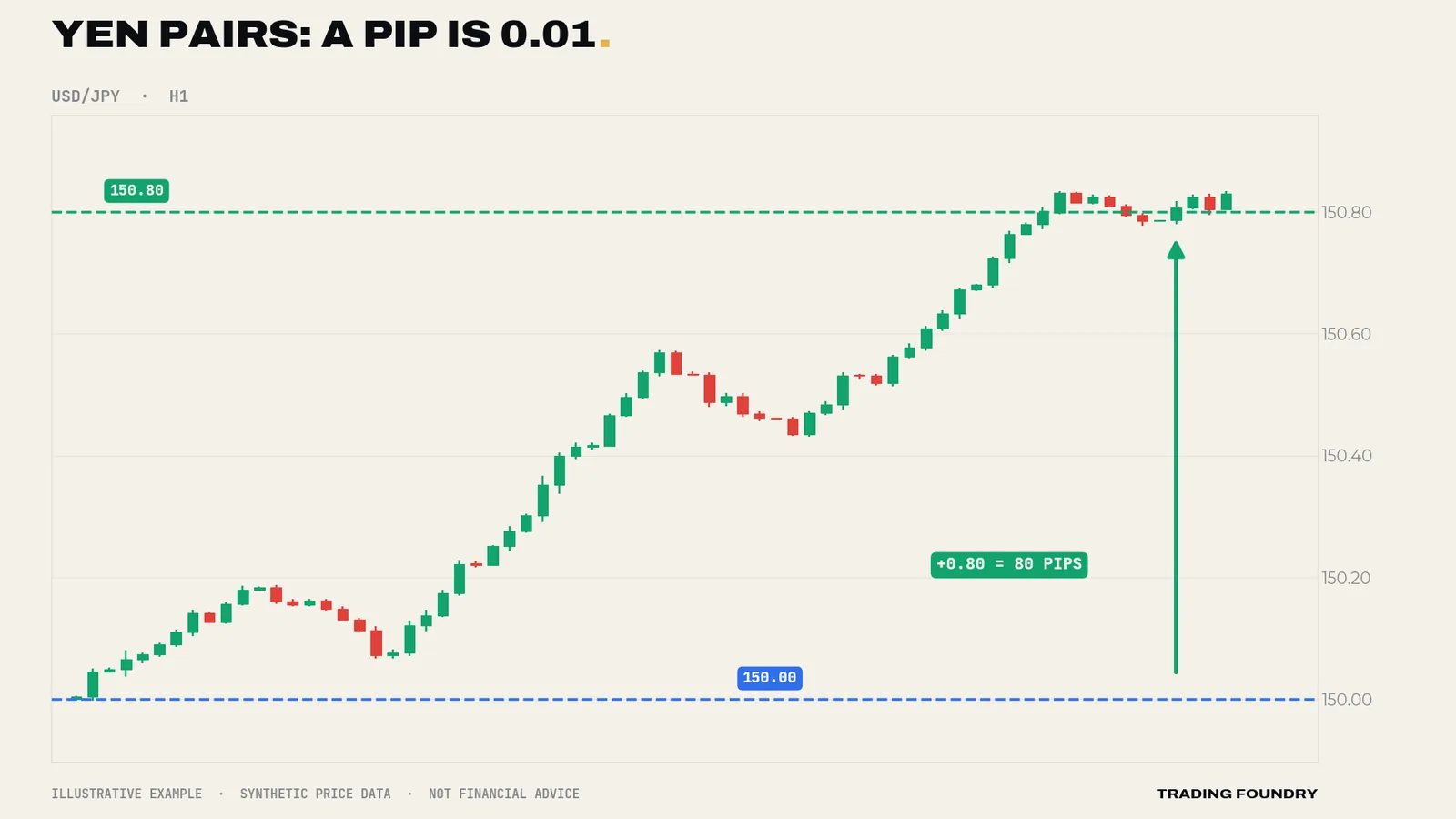
- USD/JPY rising from 150.00 to 150.80 is a move of 0.80, which is 80 pips — because on yen pairs a pip is 0.01.
Most platforms show one more digit — EUR/USD 1.08503, for example. That fifth digit is a pipette, a tenth of a pip. Ignore it when counting pips, but do not be confused when you see it.
What a lot is
A lot is the standard unit of trade size, measured in units of the base currency:
| Size | Units of base currency | Platform shows |
|---|---|---|
| Standard lot | 100,000 | 1.00 |
| Mini lot | 10,000 | 0.10 |
| Micro lot | 1,000 | 0.01 |
So buying 1.00 lot of EUR/USD means buying €100,000 worth of euros (against dollars). Buying 0.10 lots means €10,000. Buying 0.01 lots means €1,000. Most brokers allow sizes in steps of 0.01 lots, and some spread-betting accounts express size as money per point instead — the logic below is identical, only the label changes.
Do not let the big numbers alarm you. You do not need €100,000 in your account to trade a standard lot; leverage, covered in Lesson 4, lets you control it with a deposit. But the size of the position is what decides how much each pip is worth, and that is the number we care about.
Pip value: turning pips into money
Here is the one fact to memorise:
One pip on one standard lot is worth 10 units of the quote currency.
That follows directly from the definitions: 100,000 units × 0.0001 = 10. (For yen pairs: 100,000 × 0.01 = 1,000 yen — the same idea, because the pip is bigger.)
So, per standard lot:
- EUR/USD and GBP/USD: $10 per pip (quote currency is USD).
- EUR/GBP: £10 per pip (quote currency is GBP).
- USD/JPY: ¥1,000 per pip (quote currency is JPY).
Mini lots are a tenth of that ($1 per pip on EUR/USD) and micro lots a hundredth ($0.10 per pip).
Now put pips and lots together. Profit or loss is simply:
Profit or loss = pips moved × pip value per lot × number of lots
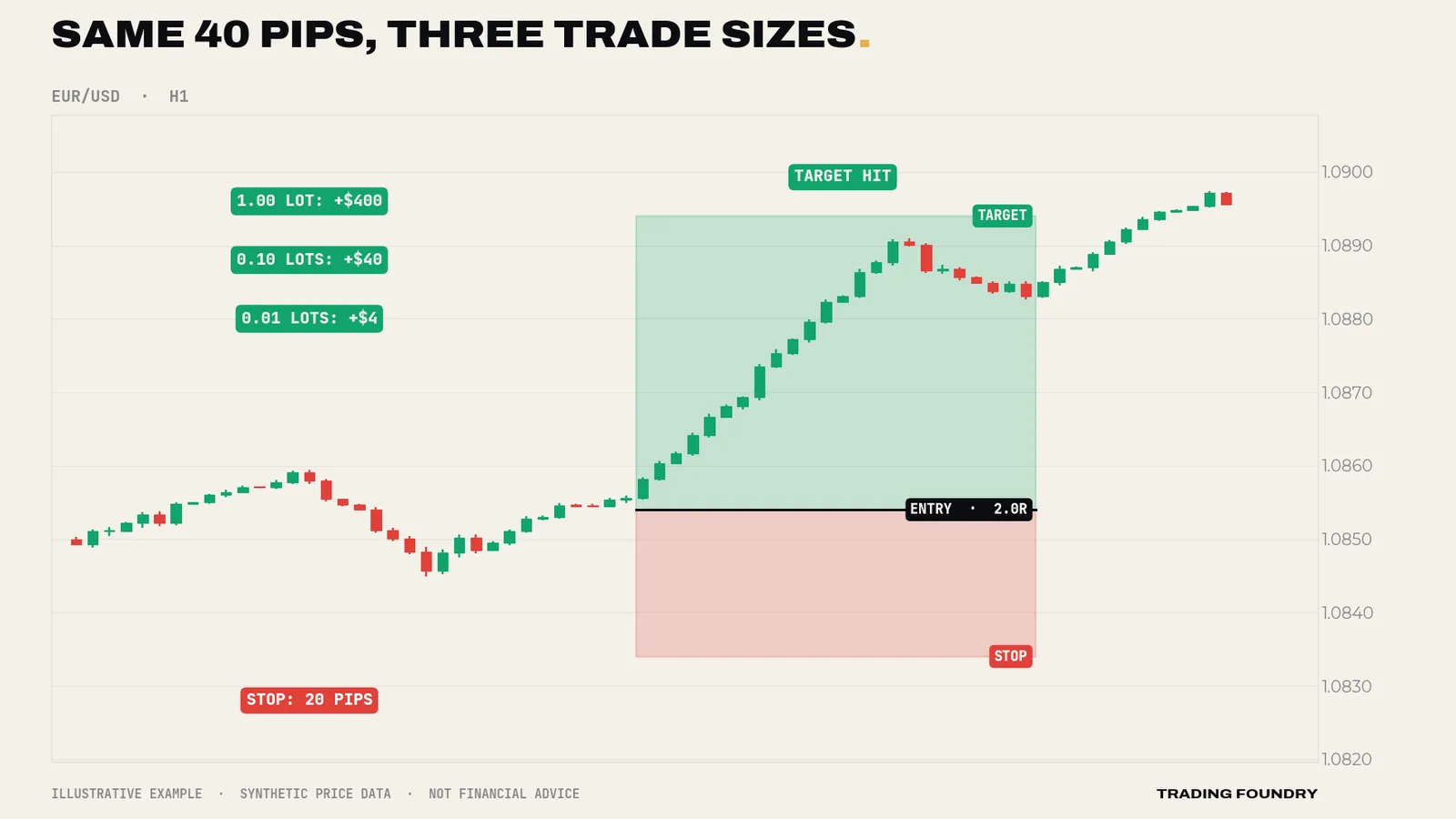
A 40-pip move on EUR/USD is worth:
- 1.00 lot: 40 × $10 × 1 = $400
- 0.10 lots: 40 × $10 × 0.1 = $40
- 0.01 lots: 40 × $10 × 0.01 = $4
Converting to your account currency
If your account is in the same currency as the quote currency, you are done. A dollar account trading EUR/USD makes and loses dollars at $10 per pip per lot.
Most readers of this course will have a pound account, though, and most popular pairs are quoted in dollars. So you convert. The rule: divide a dollar amount by the GBP/USD rate to turn it into pounds.
Worked example, all rates illustrative:
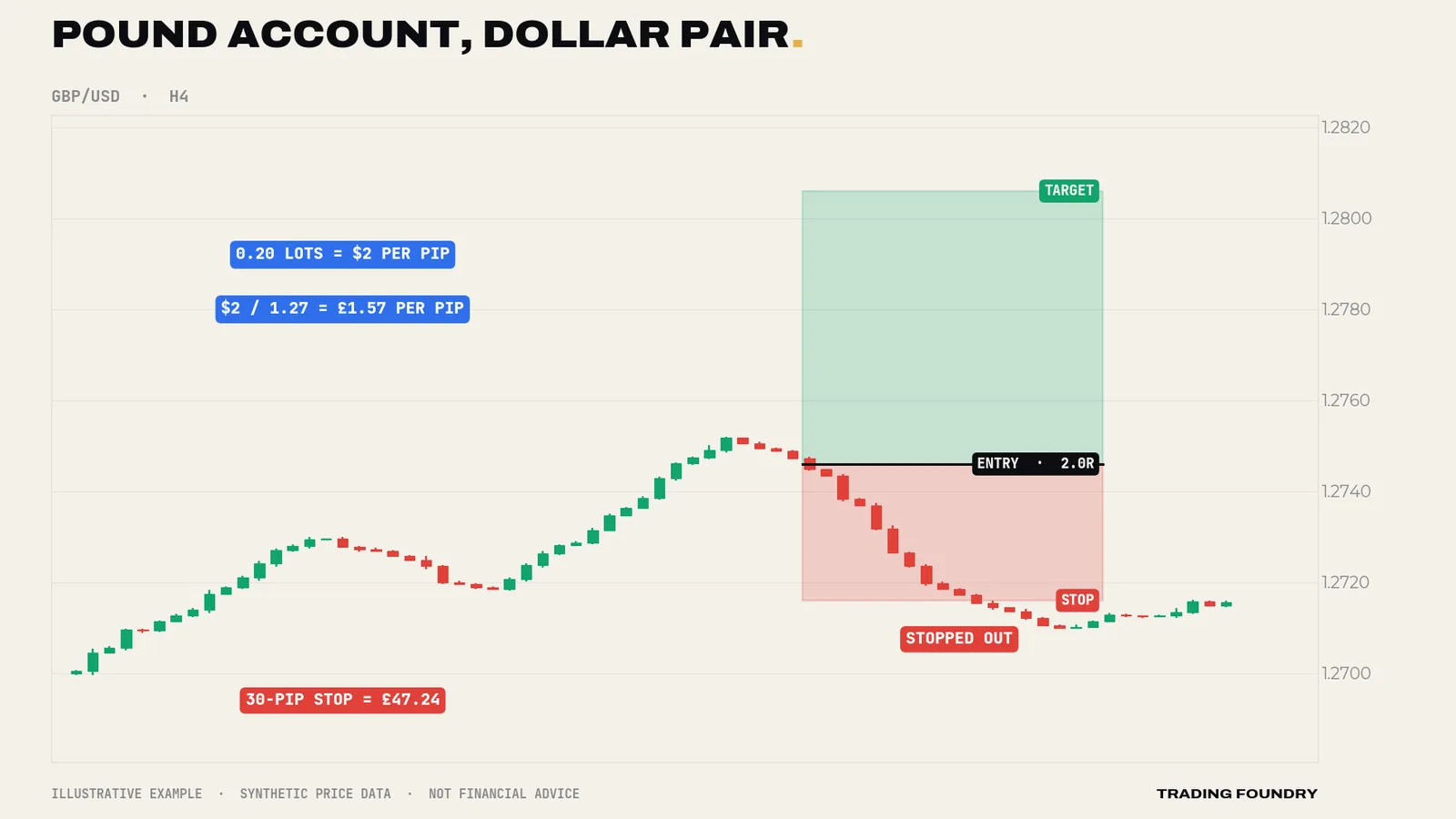
- Account in GBP. Trading EUR/USD, 0.20 lots.
- Pip value: $10 × 0.20 = $2 per pip.
- GBP/USD is 1.2700, so $2 ÷ 1.27 = £1.57 per pip.
- A 30-pip loss costs 30 × £1.57 = £47.24.
And on a cross quoted in pounds, there is nothing to convert:
- Account in GBP. Trading EUR/GBP, 0.20 lots.
- Pip value: £10 × 0.20 = £2 per pip.
- A 30-pip loss costs £60.
For yen pairs, convert the yen amount into your account currency the same way. On USD/JPY at 150.00 with a dollar account, ¥1,000 per lot is ¥1,000 ÷ 150 = $6.67 per pip per lot. With a pound account, you would divide the yen amount by the GBP/JPY rate instead. Every platform shows pip values somewhere, and a good position size calculator does all this for you — but you must be able to check it by hand, or you will not notice when it is wrong.
Going deeper
Why pip value drifts. Pip value in your account currency depends on an exchange rate, so it changes slightly as rates move. On EUR/USD in a GBP account, £1.57 per pip at GBP/USD 1.2700 becomes about £1.53 if GBP/USD rises to 1.3100. For sizing a single trade, the current rate is fine. For anyone comparing trades across months, it is one more reason to measure results in R (risk units, Lesson 11) rather than in pounds.
Pips on gold, indices and other symbols. Many platforms list gold (XAU/USD), oil and stock indices alongside currencies. Their "pip" or "point" is defined by the broker, and it is not always the same between brokers. Gold, for example, is often quoted to two decimals with one pip defined as 0.10 — but check your platform's contract specification. Never assume a pip value outside the major currency pairs; look it up.
Contract specifications are the source of truth. Every broker publishes a specification for every symbol: contract size, minimum and step size, pip or point value, trading hours, and margin requirement. Five minutes reading it for the pair you trade will save you from the commonest error in retail trading — a position ten times bigger than intended because a pip or lot was misunderstood.
Spread bets. UK spread-betting accounts express size as "£ per point" instead of lots. If one point is one pip, then £1 per point on EUR/USD is equivalent to about 0.127 lots at GBP/USD 1.2700 (because 0.127 × $10 ÷ 1.27 ≈ £1). The arithmetic of risk is the same: points moved × money per point = profit or loss.
Summary
- A pair is base/quote; buying it buys the base and sells the quote.
- A pip is 0.0001 on most pairs and 0.01 on yen pairs; the fifth digit is a pipette.
- A standard lot is 100,000 units of the base currency; mini 0.10, micro 0.01.
- One pip on one standard lot is worth 10 units of the quote currency; convert it into your account currency.
- Profit or loss = pips × pip value per lot × lots. Know the loss at your stop before every trade.
Quick quiz.
Education only, not financial advice. Charts are illustrative training examples using synthetic price data, not real market history or results.