 TRADING FOUNDRY
The Trading Sessions — When the Market Moves and When It Sleeps.
Identify the Asian, London and New York sessions in UK time, explain why price behaves differently in each, and choose trading hours that suit your pair, costs and life.
Forex is open around the clock from Sunday evening to Friday night. That fact is usually sold as freedom: trade whenever you like. In practice it is closer to a trap. The market is open for 24 hours, but it is not equally alive for 24 hours. For long stretches it drifts sideways on thin volume and wider spreads. Then, at fairly predictable times, the big centres open, volume pours in, and the day's real moves happen.
A beginner who trades whenever they happen to be free will spend much of their time in the dead hours, paying more and seeing less. This lesson shows you the daily rhythm of the market so you can choose your hours deliberately.
All times below are UK time and approximate. Daylight saving changes on different dates in the UK, US and Australia, so the edges shift by an hour for a few weeks each spring and autumn. Your broker's server clock may also use a different time zone — check what your charts are showing.
The three main sessions
The trading day follows the sun round the world's financial centres.
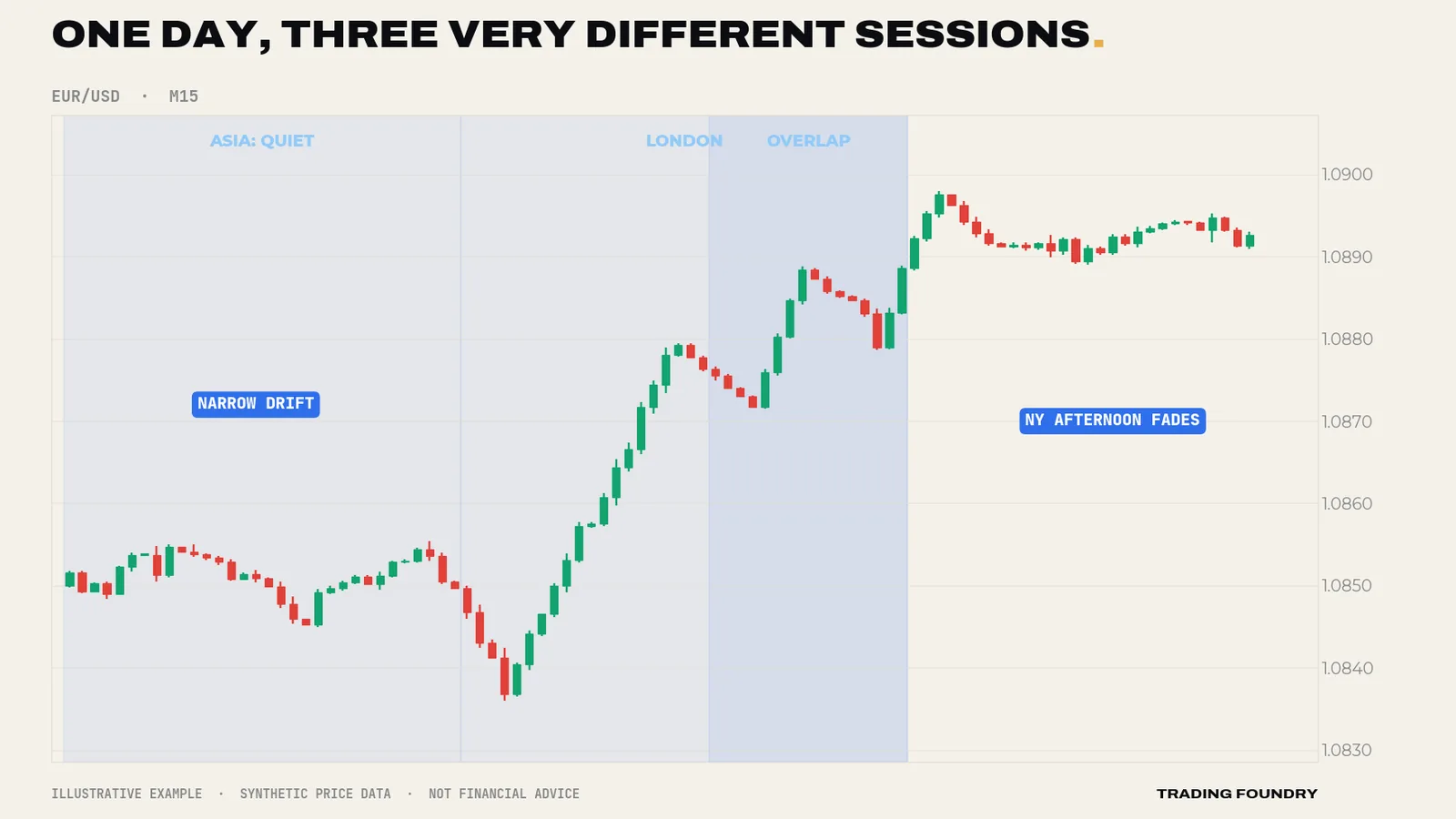
Asian session — roughly 23:00 to 08:00. Sydney opens first, then Tokyo, Hong Kong and Singapore. Activity is concentrated in yen, Australian and New Zealand dollar pairs. On EUR/USD and GBP/USD, Asian hours are usually the quietest part of the day, with price often drifting in a narrow range.
London session — roughly 08:00 to 17:00. London is the world's largest forex centre. When it opens, volume jumps across every major pair, spreads tighten, and the day's first significant move often begins. The opening hour or two can be lively and occasionally violent as overnight orders are filled.
New York session — roughly 13:00 to 22:00. US banks and funds arrive, and major US economic data is typically released at 13:30 or 15:00 UK time. From around 17:00, once London closes, activity tends to fade through the evening.
The window when London and New York are both open — roughly 13:00 to 17:00 — is usually the most liquid of the day. For the dollar majors it is often where costs are lowest and moves are cleanest, though it also contains much of the day's scheduled news.
Why sessions behave differently
There is nothing magical about the clock. Price moves when large amounts of money need to change hands, and that happens when the institutions handling it are at their desks. During the Asian session, the banks that dominate euro and sterling trading are mostly asleep; liquidity in those pairs is thinner and there is less reason for big repricing. When London opens, a wave of corporate, fund and bank orders arrives at once.
Three practical patterns follow, all of them tendencies rather than rules.
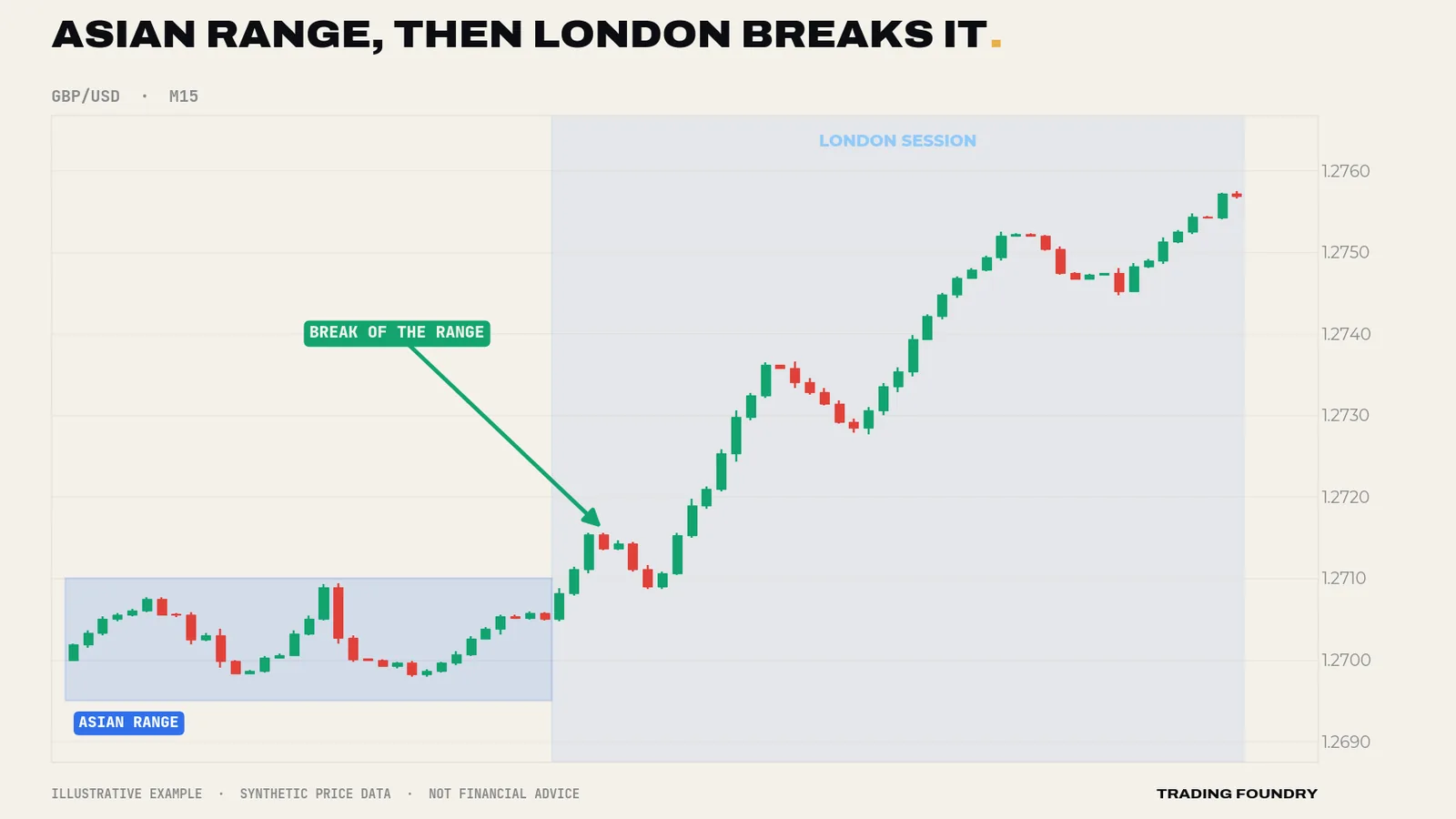
The Asian range. EUR/USD and GBP/USD often spend the Asian session in a fairly tight band. The high and low of that band become reference points for the day.
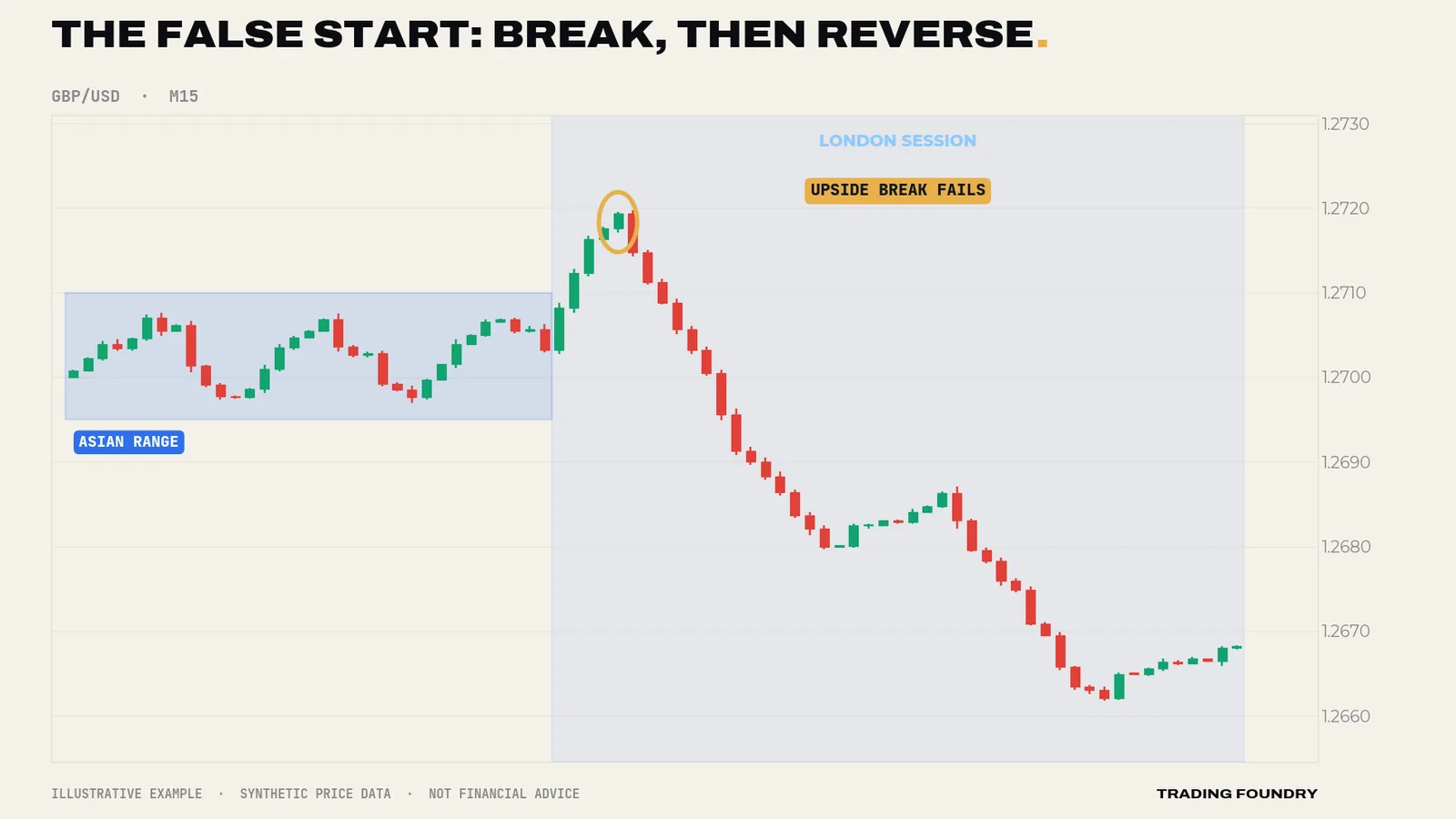
The London open move. Early London often breaks out of the Asian range. Sometimes the first break is false and price reverses through the other side — which is why waiting for the first hour to settle can be wiser than reacting to the first candle.
The overlap and the data. Many of the most important US data releases land just as the overlap begins. Price can move sharply in either direction, then continue — or completely reverse — once the dust settles.
The dead zones
Just as important as knowing when to trade is knowing when not to.
- Late New York into the roll-over (about 20:00 to 23:00). Volume fades, spreads widen around 22:00, and moves are often aimless.
- The Asian session on European pairs. Low activity, and the tight range often means small moves relative to the costs.
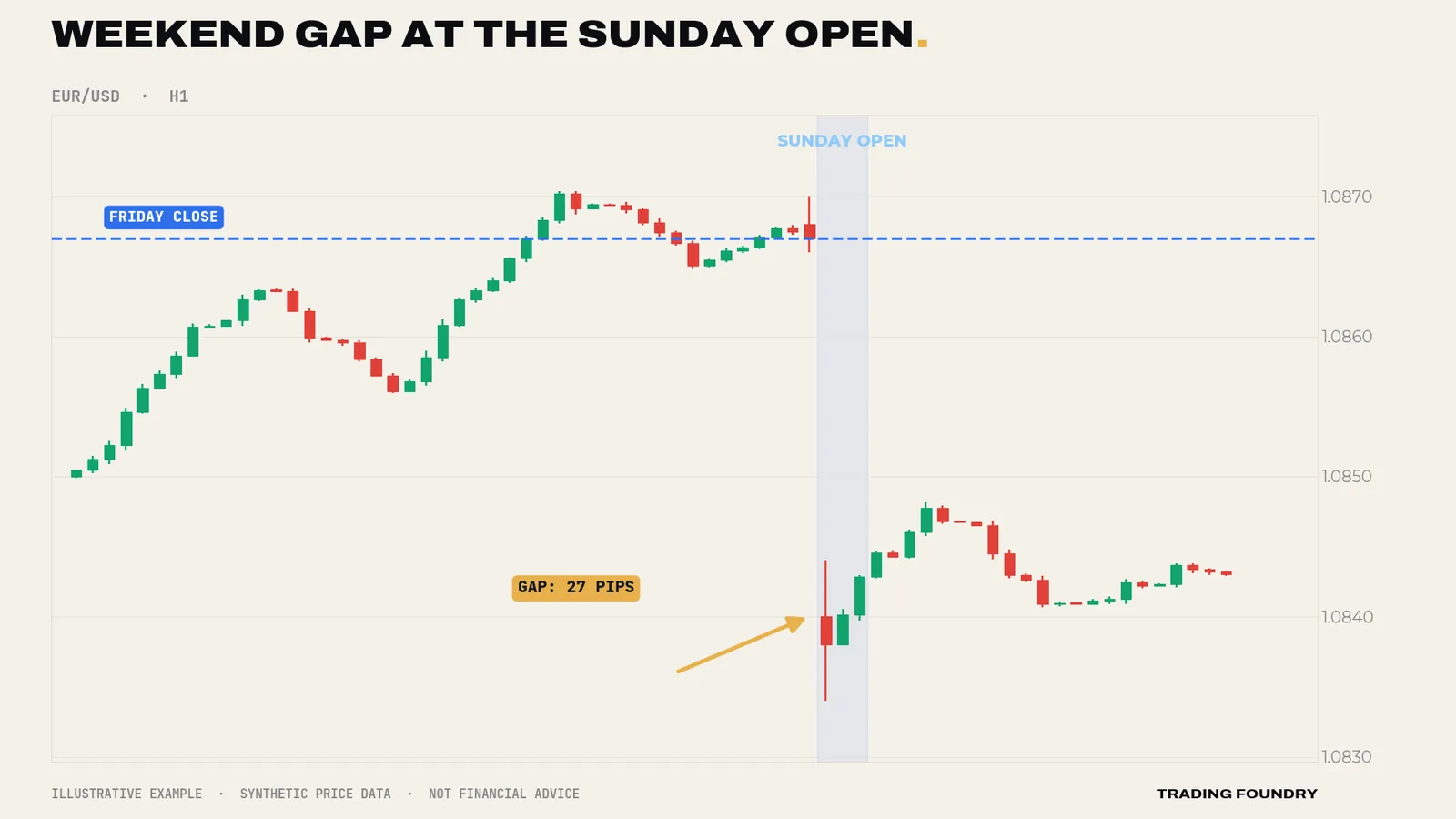
- Friday afternoon. Many participants square up positions before the weekend; moves can be erratic, and anything left open is exposed to a weekend gap.
- Sunday evening open. Prices can open away from Friday's close, and spreads are often wide for the first hour.
- Bank holidays in the UK or US, when one of the main centres is effectively shut.
Choosing your hours
For most UK-based beginners trading the dollar majors, the sensible windows are:
- 08:00 to 11:00 — the London morning, once the first 30–60 minutes have settled.
- 13:00 to 16:00 — the overlap, avoiding the minutes either side of scheduled US data.
If you work during those hours, there are honest alternatives. You can trade higher timeframes (H4 and D1), where you place orders in the evening and let them work; the session matters less because each candle spans several sessions. Or you can choose pairs that are active when you are free — yen and Australian dollar pairs during Asian hours, for instance — accepting that you then need to learn their behaviour and costs.
What you should avoid is trading short-term setups on EUR/USD at 21:00 simply because that is when you are free. It is possible, but it is the hard way.
A simple session routine
Knowing the clock is only useful if it shapes what you actually do. Here is a routine that fits the London morning for a UK-based trader, and that you can shift to the overlap if that suits your day better.
- 07:30. Open the economic calendar. Note any high-impact releases for the euro, the pound or the dollar today, and write down the 30-minute no-entry windows around them.
- 07:45. Look at the H4 chart of your pair. Label the trend and mark the nearest zones (you will learn both in Lessons 8 and 9). Mark the Asian session's high and low.
- 08:00 to 09:00. Watch, but do not act on the first move. Let the opening hour show you whether the Asian range is being broken cleanly or falsely.
- 09:00 to 11:00. This is your active window. If price reaches one of your marked zones in line with the trend and gives you a trigger, you may trade it. If not, you do nothing.
- 11:00. Stop looking for new entries. Manage anything open according to its plan, and write up the session in your journal — including the sessions where you did not trade.
The routine is short on purpose. Fixed hours protect you from the slow drift into trading whenever the screen is open, which is how most beginners end up trading the dead zones.
Going deeper
Liquidity and volatility are different things. Liquidity is how much can trade without moving price much; volatility is how far price actually moves. The London–New York overlap tends to be high in both. A news spike can be high volatility on low liquidity — dealers pull their prices, spreads widen and price jumps. That combination produces slippage.
Average range by hour. If you want evidence for your own pair, measure it: for the last few months, record the average high-to-low range of each hourly candle by time of day. The pattern is usually unmistakable. Compare that average range to your all-in cost. An hour whose average range is 6 pips with a 1.2-pip cost is a very different place to trade from one whose average range is 25 pips.
The economic calendar. Every serious broker and many free websites publish a calendar of scheduled data releases and central bank events, graded by expected impact. Check it at the start of each day. This course's simple rule for beginners is to have no new entries in the 30 minutes before and after a high-impact release on a currency in your pair, and to be wary of holding a trade with a tight stop through one.
Daylight saving. For a few weeks each March and October/November, the UK and US clocks change on different dates, so the overlap is an hour longer or shorter than usual and US data lands an hour earlier in UK time. Check, rather than assume.
- Trade the London morning (after the first 30–60 minutes) or the London–New York overlap on the dollar majors
- No new entries in the 30 minutes either side of high-impact scheduled news for either currency in the pair
- No new short-term entries from 20:00 to 23:00 UK time or on Sunday evening
- Check the economic calendar before the first trade of every day
Summary
- The day runs through the Asian (about 23:00–08:00), London (08:00–17:00) and New York (13:00–22:00) sessions, UK time.
- Most movement in the major pairs happens around the London open and the 13:00–17:00 overlap.
- The Asian range is a useful reference; London often breaks it, and sometimes breaks it falsely first.
- Late evening, Sunday open, Friday afternoon and holidays are low-quality, higher-cost hours.
- Choose hours that suit the market; if your life does not fit them, trade a higher timeframe or a different pair.
Quick quiz.
Education only, not financial advice. Charts are illustrative training examples using synthetic price data, not real market history or results.